Travels in Textiles

.

Saturday, 24 April 2010

Craft Rally, Sheffield

It was back to my home town of Sheffield yesterday to take part in the Crafts council organised 'Craft Rally'. It was part two, the first part having been held in London a month previously.

I was intrigued by what it would be all about, as I haven't known of or been to an event such as this before. It was un by the maker and curator Helen Carnac, along with Art Quest and Yorkshire Artspace in Sheffield, as a way of bringing together craft makers to discuss the situation craft is in today.


The three talkers were Adam Sutherland, director of Grizedale Arts in Cumbria, Rebecca Earley, a London based designer and researcher into eco-friendly methods of textile design and production and Neil Brownsword, a ceramicist, researcher and lecturer at Buckinghamshire New University.

I have followed the work of Rebecca Earley ever since researching for my BA dissertation Can Sustanable Design be Compatible with Fashion?, so for me her talk was the most inspirational. She came across as a very decicated, ambitious person who has achieved a lot through persevering in the competitive, struggling environment that the world of art and design is. Never having any money was particularly one of the struggles I relate to! So it made me feel inspired to carry on with my work after seeing what she'd achieved.


Moreover, she is doing some very important work at a time when climate change is a huge issue, and sustatinability is the key word currently in so many fields. In the early 90s it was discovered that textiles, after the chemical industry, take up the second largest proportion of the world's landfill sites. Later in the 90s, surveys found that designers have 80% input into how much impact the product they are designing will have on the environment. These results were what made Rebecca want to take part in finding out how the design and making of textiles can have less impact on the environment.


Her design work has focussed on making fashion out of old, found fabrics and garments and re-designing and re-making them. In her early work she cut up, stitched and manipulated old clothes, scanned these and heat pressed them onto new fabrics, creating an innovative, contemporary print. She was also one of the first to print on organic cotton and has collaborated with Kate Fletcher, another key figure in pioneering eco fashion design.

TED 'Textiles Environment Design' is one of the projects Rebecca is involved in along with other researchers, teachers and designers of Chelsea college of Art and Design where Rebecca teaches and reads. The main theme she wanted to emphasise in her talk was 'interconnectivity' which is what TED is trying to do - connecting people from all over in different fields to collaborate with ideas in working towards sustainability and environmentally friendly design.

From Neil Brownsword's talk I was drawn to how he is looking back to the booming ceramics industry that Stoke-on-Trent, his home town, once saw. As with so many other craft industries, the steel in Sheffield another example, they have almost completely dissapeared. Obviously now, the main thrust of the industry being in China, India and other Eastern countries. He mentioned the funny directions and turns the design and production of a product takes. An object might have been made in China during the T'ang Dynasty that the designers of Stoke would have taken inspration from. And when there was no industry left in Stoke, the Chinese could be seen taking English Wedgewood designs, for example and making them to sell cheaply.

I could relate an aspect of this to my own research. In India, the handicraft industry is the second largest after the agricultural. A lot more is still happening in this industry because of it being so much bigger than in Britain. However, because of industrialisation, it has seen many ups and downs. There are lots of organisations and people trying to save this industry, to sustain the traditional crafts as well as their artisans livelihoods.


One of my questions arising from the discussions we had following the talks was ' How can makers in the Uk collaborate with Indian artisans to keep a craft going?' This is already happening amongst some universities, organisation and individuals. However I wondered can we not increase the scale of this? There are very few institutions open to rural village artisans in India, the main ones being in cities and aimed at the wealthy elite. Kala Raksha, as I have mentioned in a previous post started the first design school for traditional artisans to learn contemporary design and has created a path for more to follow.


Also, in the UK in my experience, the learning of traditional crafts all over the world is not focussed on in education, neither are traditional methods. Digital technology, machinery and faster production is encouraged to be able to survive in the UK industry.

This rally was an interesting and relavant idea for networking, discusisng current situations and collaborating to overcome probelms and difficulties in craft. It was good to have a platform where, in person we could share ideas and listen to what others are doing to continue these positive ideas and work to keep hand craft going.

Thursday, 15 April 2010

A glimpse of some contemporary Arts and Crafts from the Indian Subcontinent


I visited two important exhibitions yesterday, The first was Gup Shup: From Textile to Tote, by Cath Braid and Rolla Khadduri (thanks to a comment on my wall from Hannah!) at Bradford University's Gallery II.
The two curators are partners in an organisation ' Polly&Me' which is a development project working with the embroidery artisans of Chitral, a Province in the Hindu Kush region of North West Pakistan.


For this exhibition they have give the artisans a chance to produce their own work without any of the designers' input. The results are beautiful embroidered illustrations and narratives of a significant part of the artisans' own life. It might be a childhood memory or a particular routine chore or an event. These embroideries were made into fashionable modern leather bags. Some were exhibited as art pieces.


I particularly enjoyed the story of one lady remembering her baby brother being born and having to go out and get some chicken with her father for the chicken soup supper they would be having. As the girl carried the chicken in a bag on her way home, she got separated from her father. A scary looking dog appeared enticed by the tasty smell of the chicken. Frightened, she ran into someone's house where the family living there shooed the dog away and looked after her until it was safe to go home. On arriving home she got a telling off for being late, but let off when hearing of her traumatic journey! They all sat laughing while she told the story over chicken soup with the new baby.


The next exhibition was between Kismet and Karma, South Asian Women Artists Respond to Conflict at the Leeds Art Gallery, an exhibition organised by Shisha, an agency that promotes and supports contemporary South Asian art and craft.

Above image: Elastic Dress, Anoli Perera, 2010

The artists were addressing contemporary issues faced by South Asian women. The above image is a huge installation of a dress made from knots of elastic. It stretches and clings to fit any body shape. Perera is dealing here with issues of women's body image and how it is perceived in contemporary society.


I enjoyed Tayeba Begum Lipi's work. She explores female identity in post colonial, modern South Asia through portraiture work and iconography. One of her pieces was a collaborative painting with a group of women from a Bangladeshi village community who traditionally tattoo themselves as a part of signifying each others' identity. It was a painting of a females's back decorated in these traditional tattoo patterns.

Wednesday, 17 March 2010

Evolution and Influence in Indian block printed designs


An image of a fragment of fabric printed in Gujarat for the Egyptian Market. Excavated at Fostat (old Cairo), dated to the 14th Century AD.


An image taken from the book Trade, Temple and Court, Indian Textiles from the Tapi Collection Ruth Barnes, Steven Cohen and Rosemary Crill, Gujarat Late 13th/early 14th century, traded to Sulawesi, eastern Indonesia, cotton, resist print and mordant - dyed.


My own picture taken during my recent trip to Ajrakhpur. This is a sample book of the different stages in the ajrakh print process. It is the work of Dr. Ismail Khatri, influenced by the above ancient pieces, said to have been of the same the same tradition as ajrakh, printed by Ismail's ancestors.
According to the authors of Trade, Temple and Court, the motif in the above images was named daun bolu - 'leaf of the sirih plant', the piper beetle that is an essential ingredient in chewing beetle by the Toraja community in Sulawesi.

This is another early textile find from Fostat. The image is from Ruth Barnes' Indian Block Printed Cotton Fragments in the Kelsey Museum, The University of Michigan. Like the above image it will have been resist dyed and again for the Egyptian market. The red would have been achieved using madder dyeThis image is another taken from the Tapi Collection book and is again from Gujarat, traded to Sulawesi, eastern Indonesia from the 17th/18th century. The teardrop like motifs in these two images bear resmeblance. This motif is still used regularly today. Although from my experinece more in Rajasthan than Gujarat. This motif is popular amongst Anokhi designs. A contemporary version a Tapi booti of the pattern is shown here printed on tussar silk and made into a book.


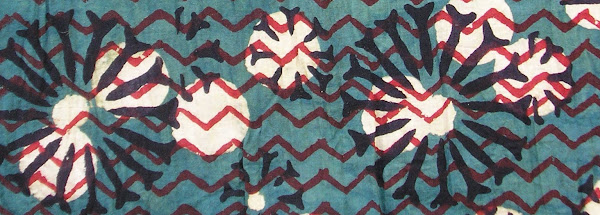
Another Fostat print from the 14th century on the left and on the right a similar print from Ismail Khatri's workshop, January 2010. Again this is a sample book of the print process stages.

I find it fascinating seeing patterns in cloths hundreds of years old still being used today. I wonder whether they have the same meanings and names given to them now as they did then. Also how would the translations of the patterns and uses of the cloths by the Toraja of Indonesia differed from the Egyptians, and the Gujaratis themselves.

Thursday, 4 March 2010

A long cold winter


This picture of amazing icicles was taken on the snake pass on my journey from Manchester to Sheffield. There wasn't any snow or hardly any ice, but this area missing the sun's gaze had kept its cold and the trees clung onto its beautiful sculptures. Quite a surreal sight on my first day back from India, being so completely contrasting to the sights I'd seen in the past few weeks!

Yet another scattering of snow a few weeks later brought about many a pretty view on a country walk in Cheshire.

Saturday, 27 February 2010


Some pictures of jewellery I've making out of cut offs of Indian printed fabrics, collected buttons, beads and other stuff.

I'll be selling these at the Dignity Craft Fair in Didsbury, Manchester on Saturday 13th March as well as in my Folksy shop online.


Saturday, 20 February 2010

Some videos I shot during my trips to India.


This one shows a Rabari wedding I attended. The Rabaris are a cattle herding community of Gujarat and Rajasthan in India and Sindh in Pakistan. The men own and herd cattle while many of the women are embroidery artisans. They learn the art from a young age and spend the years leading to marriage producing items for their dowry. These include clothes she and her future husband will wear, gifts for the in laws and decorations for her new home. You can see in this film how decorative and intense the embroidery is.

Marriage is a huge and profound moment in the lives of the rural communities . They bring together men often separated by work and provide opportunity for women to bond.

This film shows a unique celebration of thirty five marriages happening all at the same time in the town of Bhuj in Kachchh, Gujarat. This is an unusual occurrence, but it happened that there were so many engagements happening over a period of time that they decided to celebrate them all together in one huge ceremony.

The weddings are celebrated on Lord Krishna's birthday, and as well as being a celebration are a series of symbolic gestures of which the embroidered cloth plays an important role.

On the 26th January 1950, India declared itself as a Republic and has since been annually celebrated as a holiday. This video was taken on 26th January 2010 so it was the 60th birthday of India as a Republic.

On the same date in 2001 there was a devastating earthquake in Gujarat. Bhuj was badly affected. So for the people of this region it brings back tragic memories but also reminds them of their collaborative efforts to re-build their lives and positive thoughts for the future.

Concerts like this are quite rare in Bhuj as these musicians are from various villages around Bhuj in the desert region of Kachchh. Some villages are very isolated and so provide the musicians with difficulty to get together with other fellow musicians. There was first a concert a 7 am which fitted beautifully with the sun rising, There was then a concert a sunset which saw a huge gathering of listeners. A unique event that brought locals, tourists, musicians and others from far off places together to listen to some lovely traditional Kachchhi tunes.

Tuesday, 9 February 2010

Experimental, innovative and contemporary block prints


The next day I managed to visit the other Juned and his father Abdul Raheman. Another graduate of KRV, Juned had produced some pieces inspired by Islamic architecture and prayer mats. I tried to learn some of the names of the traditional designs and he showed me all the dyes they use. Juned himself uses all natural dyes, including myrobalen, tamarind powder for a thickener, shells from Mandvi beach where lime is extracted from for use in the mud resist paste, indigo, madder root, dried pmegranate skins, turmeric and others. He introduced me to his brother Faiz Mohammed who also block prints but uses chemical dyes. Chemically dyed ajrakh tends to be for local and cheaper markets such as Gamthiwalas in Ahmedabad and other market sellers in the cities.

I learnt that Juned's uncle is Mussabhai, whom I met on my last visit so asked if he could take me to his house, which he did and I was greeted by a huge group of excitable children, some of whom were his grandchildren, and extended family, and neighbours. So before getting to see any textiles I had to spend about half an hour taking photos, which was fun at first but when asked to take one of each individually and then different combinations I started to get impatient to chat to Mussabhai and his son Auresh.I eventually escaped but was still jumped on and asked to take more every so often while in the cloth haven. Mussabhai is quite an outgoing character and even though he doesn't speak much English, talks as much as he can. While showing me his son Auresh's work, poor Auresh hardly got a word in. Auresh, only 18 years old is another graduate of KRV. While showing me his son Auresh's work, poor Auresh hardly got a word in. Auresh, only 18 years old is another graduate of KRV and Mussabhai had plenty of reason to be hugely proud of his son's work as he had produced some beautiful pieces. I was in awe at every single one and didn't mind taking each ones' photo as Mussabhai eagerly asked me to.
I love this one of the horses. Its so different from any of the other prints I've seen. He had a really good eye for pattern and colour. He used only natural dyes on silk and produced a large collection of dupattas and some saris too. I wanted to buy some but they were saving them for an exhibition. I'd love to exhibit some of them here so said to Auresh to let me know what he's got left after the exhibition, probably none if everyone likes them as much as me!
Sale Mohammed had also produced some beautiful innovative prints for his KRV graduate collection. It consisted of women's garments such as short kurtas, skirts and trousers. HIs collection focussed on placement of blocks. He had used the composition of a traditional block, taken the design away and replaced with his own new design. He used both chemical and natural dyes, and I have to say I prefered the colours the natural dyes had produced as some of the chemical produced prints were more a little garish. He's done well in experimenting though.